Real estate investment teams are racing against time. From the moment an opportunity hits the market to final investment committee approval, every hour counts. Yet acquisitions teams spend the majority of their time on tasks that don't require their expertise: extracting data from offering memorandums, validating financial assumptions, comparing market comps, drafting investment memos, and assembling diligence packages.
The numbers are stark: Most real estate investment teams spend 50-60% of their time on documentation and data extraction rather than actual investment analysis and strategy. A typical $50M acquisition requires 80-120 hours of manual work just to compile, validate, and format information that already exists in source documents.
AI agents are fundamentally changing this equation. Unlike basic automation that simply moves data around, AI agents can read offering memorandums, validate financial models, research market claims, draft investment recommendations, and assemble comprehensive diligence packages—all while maintaining the rigor and auditability that institutional investors require.
Here are six AI agents that are already transforming how real estate investment teams evaluate and execute deals.
1. OM Summarizer Agent: Instant Investment Intelligence
The Problem
Reviewing private lending operating memorandums is tedious and time-consuming. Analysts spend 2-4 hours per OM manually extracting target returns, cash-on-cash yields, tax benefits, risk profiles, hold periods, and sponsor track records—all before even beginning actual analysis.
How the AI Agent Works
The OM Summarizer Agent transforms 100+ page OMs into actionable investment intelligence:
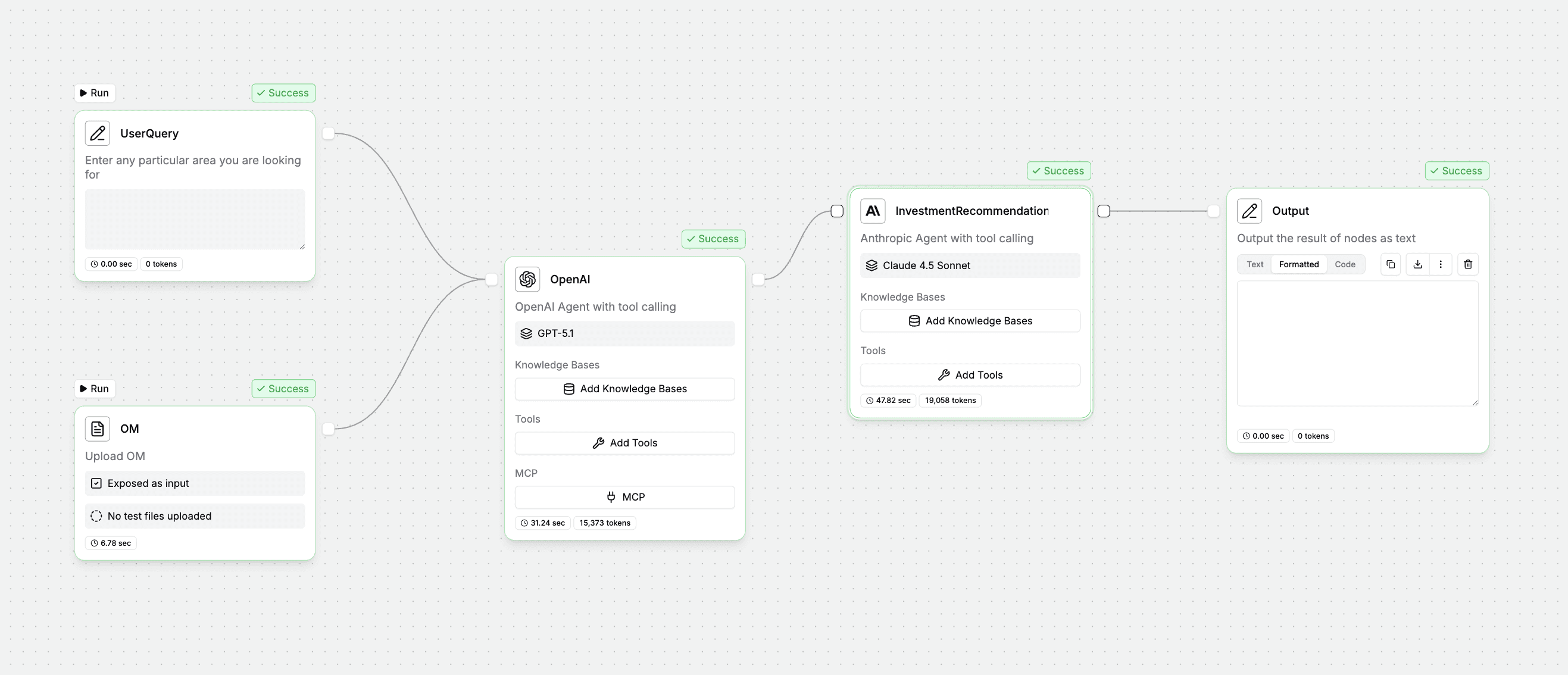
User uploads an Operating Memorandum PDF
AI extracts critical investment data points:
Target IRR and cash-on-cash returns
Investment structure and capital stack
Tax benefits and depreciation schedules
Risk profile and sensitivity analysis
Lock-in periods and liquidity terms
Sponsor background and track record
AI evaluates the opportunity against current market conditions:
Comparable deal terms in the market
Current interest rate environment
Sector-specific risk factors
Market timing considerations
Investment recommendation is generated with supporting rationale and citations
Results
Key metrics extracted in 5 minutes vs. 2-4 hours of manual review
AI-generated preliminary investment recommendation based on market conditions
Standardized OM analysis across entire deal pipeline
Investment committee materials ready for review in minutes
Who It's For
Real estate investment managers, acquisitions analysts, portfolio managers, and family office investment teams.
2. Acquisition Analysis Memo Drafter: Automated Investment Committee Materials
The Problem
Creating comprehensive investment memos requires manually synthesizing offering memorandums, underwriting models, market research, comp analyses, and risk assessments into a polished 10-20 page document. This process typically takes 8-12 hours per deal and represents a major bottleneck in the acquisitions pipeline.
How the AI Agent Works
The Acquisition Analysis Memo Drafter automates the generation of professional investment committee memos:
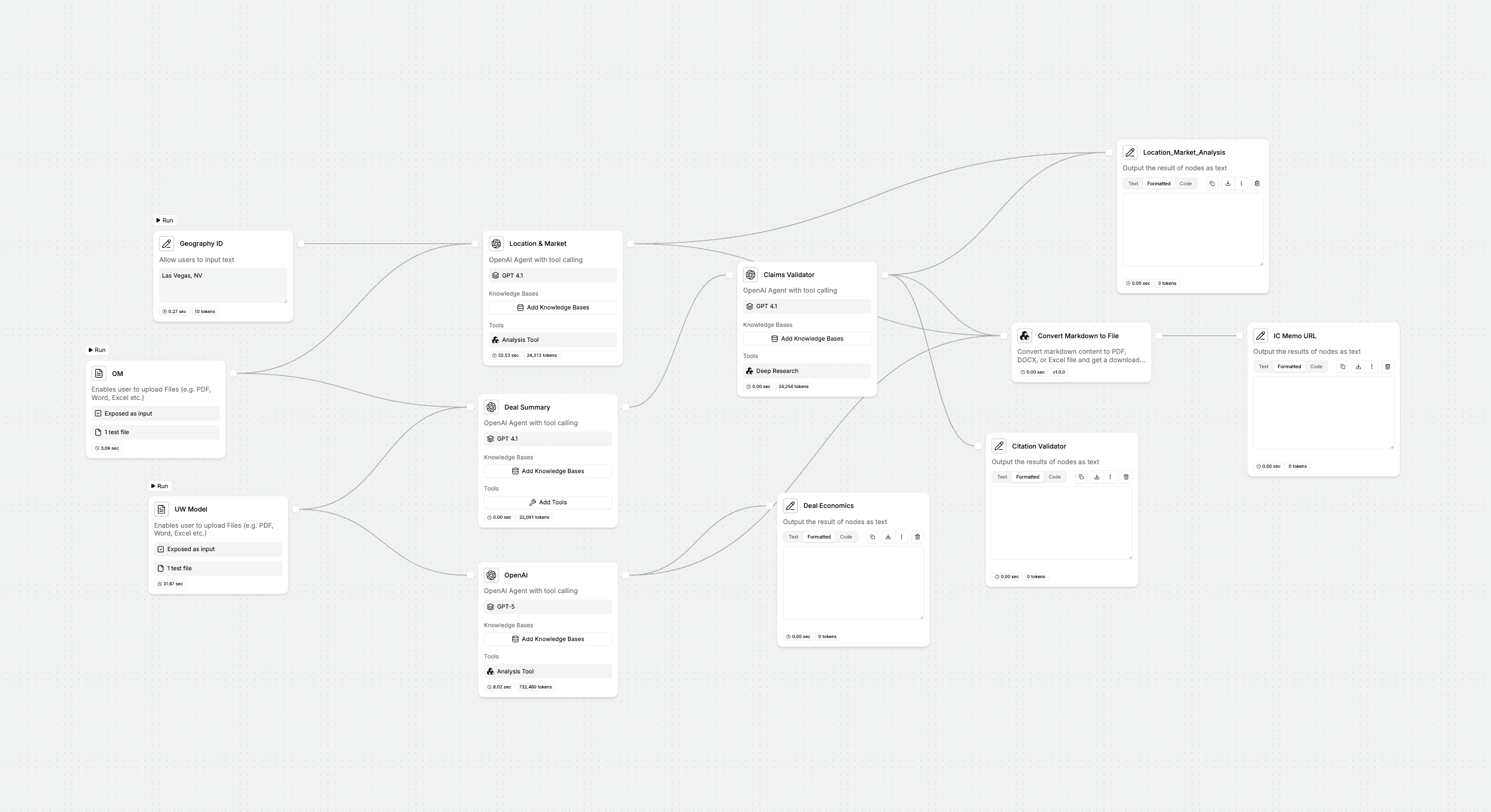
User uploads offering memorandum (PDF) and underwriting model (Excel)
AI extracts and synthesizes multiple layers of information:
Property details and market context
Deal economics and return projections
Capital requirements and financing structure
Key assumptions and sensitivity analysis
Sponsor background and experience
AI researches and validates key claims from the OM:
Market growth projections
Comparable transaction data
Submarket dynamics and trends
Regulatory or zoning considerations
Comprehensive investment memo is generated with:
Executive summary and recommendation
Market overview and opportunity
Financial analysis and returns
Risk assessment and mitigants
Implementation timeline
Claims are tagged as validated, needs verification, or contradicts research
Results
Investment memos generated in 30 minutes vs. 8-12 hours
OM assertions automatically fact-checked against market data
Consistent memo structure across all deals
Red flags and inconsistencies surfaced automatically
Investment committee gets deeper analysis in less time
Who It's For
Acquisitions teams, investment analysts, portfolio managers, and asset management groups at institutional investors, REITs, and private equity firms.
3. OM Generator Agent: Professional Marketing Materials in Minutes
The Problem
Creating professional Operating Memorandums for capital raises or asset sales requires hours of manual work: compiling financial models, writing property descriptions, researching market context, formatting multi-section documents, and ensuring consistent branding. A quality OM typically requires 12-16 hours of analyst time.
How the AI Agent Works
The OM Generator Agent automates comprehensive OM creation:
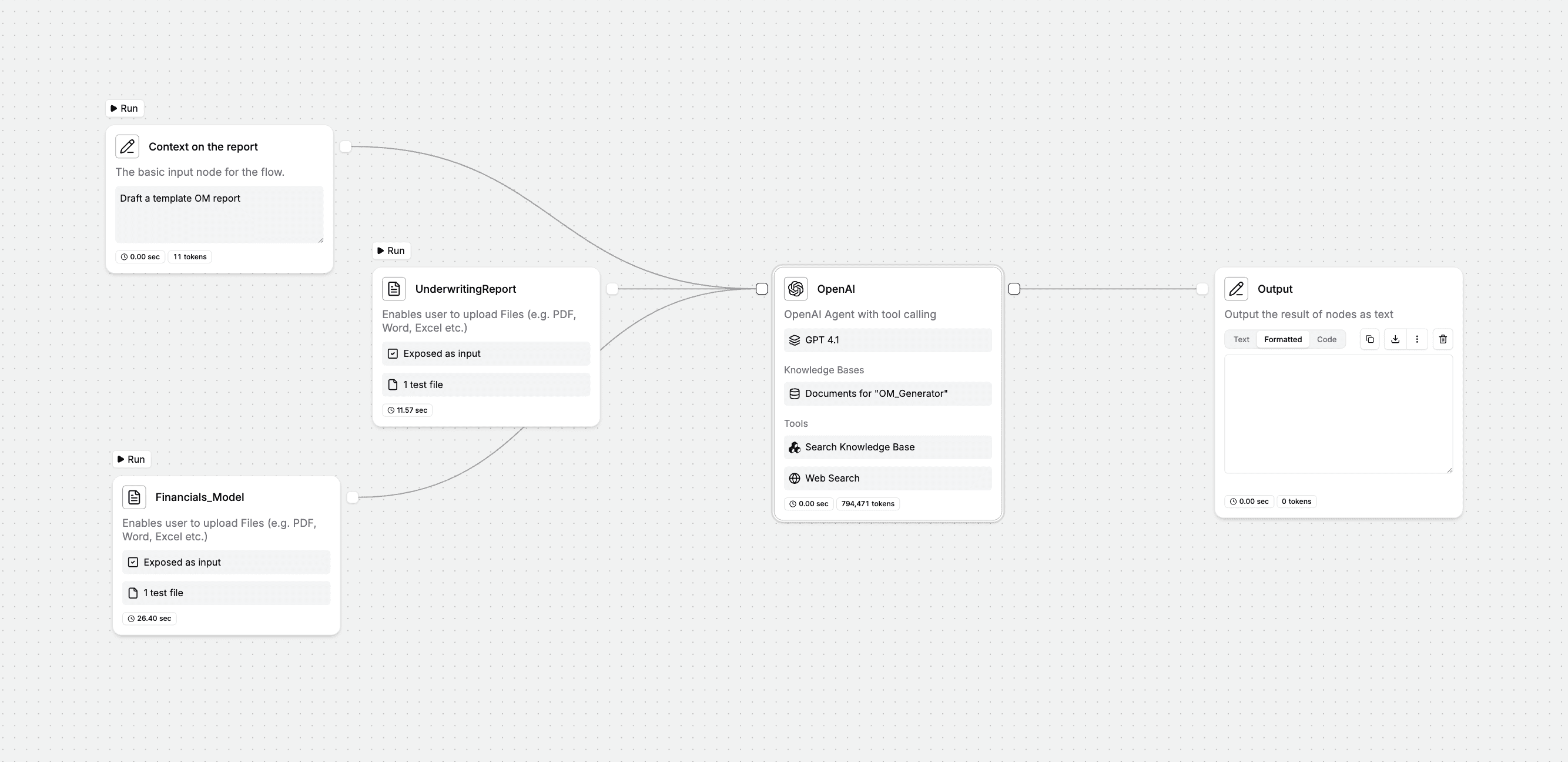
User provides underwriting report, financial model, and any additional context (property photos, market reports, tenant information)
AI processes and extracts key data from uploaded documents:
Property specifications and location details
Historical and projected financials
Market positioning and competitive advantages
Value-add opportunities or business plan
AI researches supporting market context:
Submarket demographics and growth trends
Comparable sales and leasing activity
Economic drivers and employment data
Complete OM is generated with multiple sections:
Executive summary and investment highlights
Property overview and specifications
Market analysis and opportunity
Financial performance and projections
Management team and track record
Transaction structure and terms
Professional formatting with consistent branding and layout
Results
Multi-section OMs generated in 20 minutes instead of 12-16 hours
Consistent structure and branding across all offerings
Market research automatically incorporated
Faster time-to-market for capital raises and dispositions
Analysts focus on strategy rather than document assembly
Who It's For
Investment sales teams, capital markets groups, asset managers preparing for refinancing or disposition, and sponsors raising equity for acquisitions.
4. Zoning & Entitlement Diligence Agent: Accelerated Development Feasibility
The Problem
Early-stage acquisitions of development sites or value-add opportunities stall for weeks while analysts dig through municipal zoning codes, entitlement processes, planning commission requirements, environmental restrictions, and historical approval timelines. This research typically requires 20-40 hours per site and often involves calling multiple city departments.
How the AI Agent Works
The Zoning & Entitlement Diligence Agent automates regulatory research:
Property address and development concept are provided
AI researches relevant regulatory documents:
Municipal zoning code and overlay districts
Comprehensive land use plans
Historic district requirements
Environmental restrictions (wetlands, floodplains, protected species)
Recent zoning amendments or variances
AI extracts critical constraints and opportunities:
Allowable uses by right vs. conditional use
Maximum density and height restrictions
Parking and setback requirements
Required entitlement processes and timelines
Historical approval rates for similar projects
Known community opposition or support factors
Risk assessment is generated:
Likelihood of entitlement approval
Estimated timeline and costs
Alternative use scenarios if primary plan fails
Political or community risk factors
Summary report delivered with citations to source documents
Results
Zoning and entitlement analysis completed in 2-3 hours vs. 20-40 hours
Allowable uses, density, and timeline constraints clearly summarized
Risk factors and alternative scenarios identified early
Investment teams make faster go/no-go decisions
Fewer costly surprises during entitlement process
Who It's For
Development teams, land acquisitions groups, value-add investors, and opportunistic funds evaluating sites with zoning or entitlement complexity.
5. Operating Partner Reporting Agent: Streamlined LP Communications
The Problem
Quarterly updates from operating partners and property managers arrive as fragmented PDFs, Excel models, narrative emails, and informal updates. Synthesizing these into polished LP reports requires manually extracting performance data, reconciling numbers across sources, and drafting executive summaries—typically 4-6 hours per property per quarter.
How the AI Agent Works
The Operating Partner Reporting Agent automates LP reporting:
Reporting packages are uploaded from multiple sources:
Property manager financial reports
Operating partner narrative updates
Capital expenditure tracking spreadsheets
Leasing activity reports
Photos and property condition updates
AI extracts key performance metrics:
Occupancy and leasing velocity
Revenue and expense performance vs. budget
NOI and cash flow generation
Capital improvements completed and planned
Lease expirations and renewal activity
AI reconciles numbers across different sources and flags discrepancies
AI drafts executive summary highlighting:
Performance vs. underwriting assumptions
Key accomplishments and challenges
Upcoming decisions or capital requirements
Value creation progress and timeline
LP-ready report is generated with consistent formatting and branding
Results
Quarterly LP reports generated in 30 minutes vs. 4-6 hours per property
Consistent reporting format across entire portfolio
Performance variance automatically flagged
Asset managers focus on strategy rather than data compilation
LP confidence increased through timely, professional communications
Who It's For
Asset managers, portfolio managers, investor relations teams, and fund administrators managing institutional capital.
The Competitive Advantage: Speed, Accuracy, and Capacity
The real estate investment teams implementing AI agents aren't just working faster—they're fundamentally changing what's possible.
The typical impact across the deal lifecycle:
Origination & Screening:
85% faster initial OM review and screening
3x more deals evaluated with same team size
Earlier identification of red flags and deal killers
Underwriting & Analysis:
80% reduction in investment memo drafting time
Deeper analysis through automated fact-checking and market validation
More time for scenario modeling and risk assessment
Due Diligence:
70% faster lease abstraction and document review
60% reduction in zoning and entitlement research time
Compressed diligence timelines without sacrificing quality
Asset Management:
75% faster quarterly reporting cycles
Standardized reporting across entire portfolio
Earlier identification of performance issues
The net result: Investment teams can evaluate more opportunities, conduct deeper analysis, execute faster, and manage larger portfolios—all with the same headcount.
Real-World Impact: Case Study
A mid-market multifamily investor implemented three AI agents (OM Summarizer, Acquisition Memo Drafter, and Lease Abstractor) across their acquisitions team:
Before AI Agents:
12-15 opportunities evaluated per quarter
8-10 day average time from OM receipt to investment committee
2-3 week due diligence timeline
5-person acquisitions team
After AI Agents (6 months):
35-40 opportunities evaluated per quarter
2-3 day average time from OM receipt to investment committee
1 week due diligence timeline
Same 5-person acquisitions team
The firm won 2 competitive deals they would have passed on previously due to timeline constraints, representing $85M in acquisitions that generated immediate value through faster execution.
Critical Success Factors: Getting AI Agents Right
While AI agents deliver dramatic efficiency gains, implementation requires attention to three critical areas:
1. Data Quality and Governance
AI agents are only as good as the documents and data they process. Successful implementations establish:
Standardized file naming conventions
Clear document version control
Defined data sources of truth for validation
Regular audit of AI outputs against human review
2. Human-in-the-Loop for High-Stakes Decisions
AI agents should accelerate analysis, not replace human judgment. Best practices include:
Human review of all investment recommendations
Confidence scoring that flags uncertain extractions
Clear escalation paths for complex scenarios
Audit trails showing AI reasoning and source citations
3. Integration with Existing Workflows
AI agents should fit seamlessly into current processes:
Integration with deal management platforms (Juniper Square, Kushner, etc.)
Export to familiar formats (Excel, Word, PowerPoint)
Compatibility with existing underwriting models
Alignment with investment committee requirements
Getting Started with AI Agents for Real Estate Investment
The barrier to entry for AI agents has dropped dramatically. You don't need a data science team, custom development, or massive budgets.
Platforms like StackAI provide:
No-code, drag-and-drop agent builder for investment workflows
Pre-built templates for OM analysis, memo drafting, and due diligence
Secure, on-premise or hybrid cloud deployment for sensitive deal information
Native integrations with Excel, SharePoint, Box, and major deal management platforms
Role-based access controls and complete audit trails for compliance
SOC 2, ISO 27001, HIPAA-ready infrastructure for institutional requirements
Most investment teams deploy their first AI agent in under two weeks and see measurable ROI within 30 days.
Next Steps: Transform Your Investment Operations
The real estate investment firms winning deals in 2026 aren't just faster—they're leveraging AI agents to evaluate more opportunities, conduct deeper analysis, and execute with conviction while competitors are still compiling data.
Ready to see AI agents in action?
Get a demo to explore how AI agents can transform your investment process
Download the white paper: AI Agents: 10+ Use Cases Transforming Real Estate

Jenny Liang
AI Strategist at StackAI